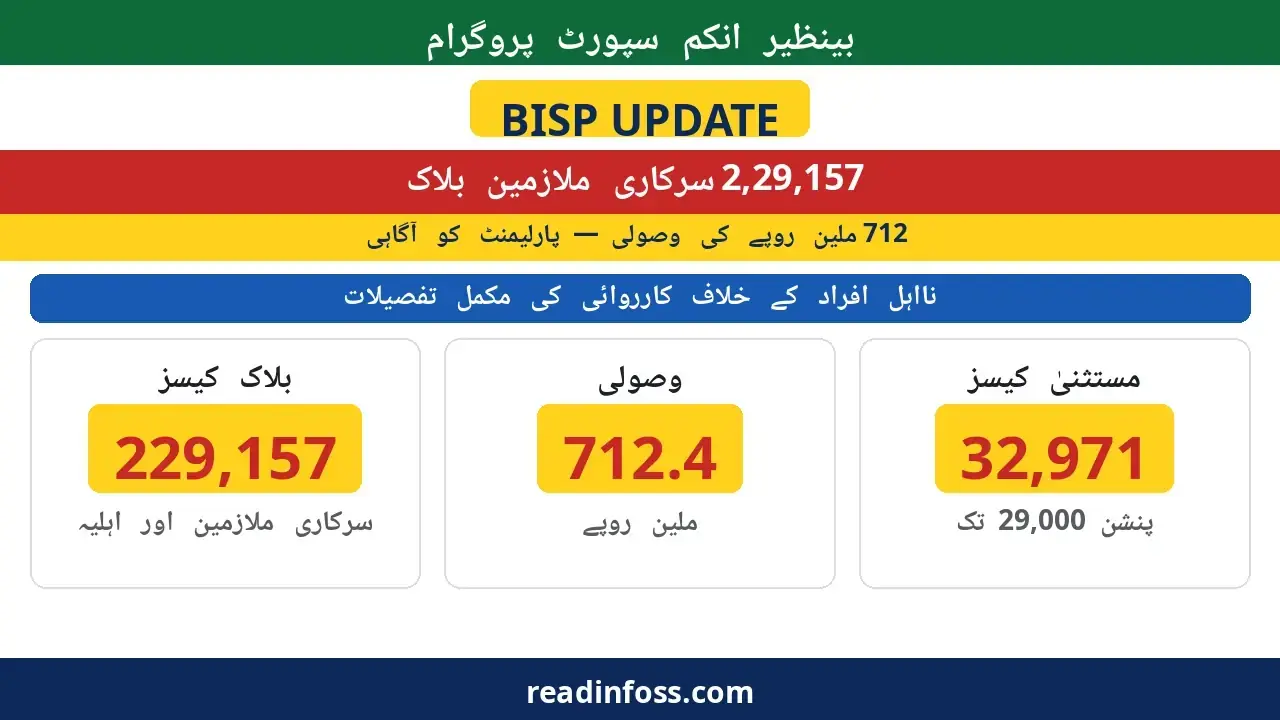
The Benazir Income Support Programme (BISP) has blocked 229,157 government employees or their spouses from receiving financial assistance after identifying them through audits — and has recovered Rs712.4 million from ineligible recipients. The figures were disclosed by the government in a written reply to a parliamentary question, as reported by TechJuice today, 23 October 2026.
This is a major cleanup of the country’s flagship cash-assistance programme, and it directly affects thousands of households. This guide explains what was announced, who is affected, what the recovery means, how to check whether your own BISP record is affected, and where to complain if money is being deducted from your payment.
At a Glance: BISP Crackdown on Ineligible Recipients
| Feature | Details |
|---|---|
| Blocked cases | 229,157 (government employees or their spouses) |
| Total recovered | Rs712.4 million |
| Recovered via FIA | Rs545.784 million |
| Recovered from BISP employees | Rs21.550 million |
| Recovered from other departments | Rs145.066 million |
| BISP employees under action | 236 (recovery + disciplinary proceedings) |
| Exempted from recovery | 32,971 cases (pension Rs29,000 or below) |
| Announced by | Minister for Poverty Alleviation Syed Imran Ahmad Shah, written reply in Parliament |
| Reported | 23 October 2026 |
What Exactly Did the Government Announce?
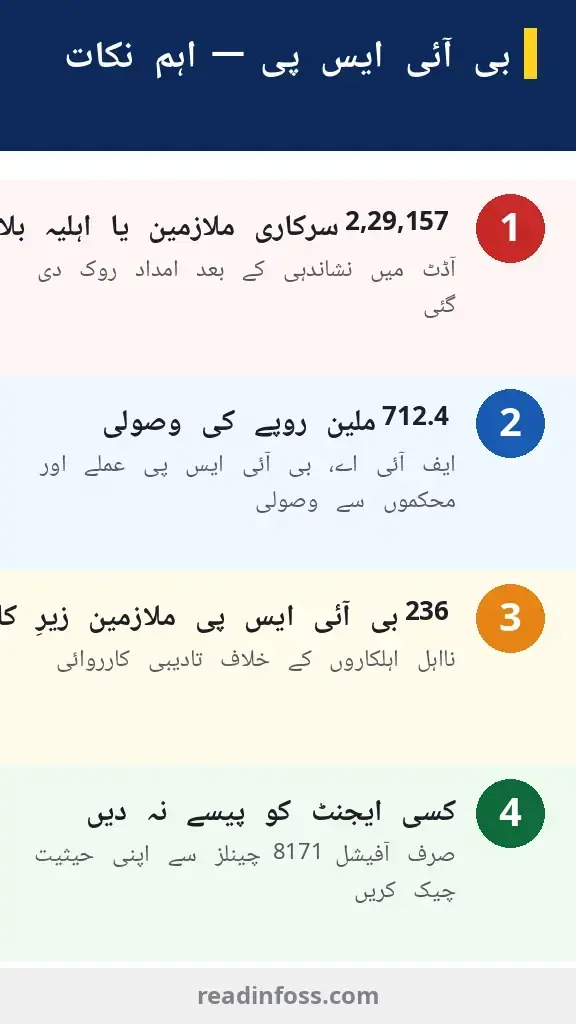
In a written reply to a parliamentary question, the Minister for Poverty Alleviation and Social Safety, Syed Imran Ahmad Shah, told Parliament that BISP had blocked 229,157 government employees or their spouses from the programme after identifying them through audits.
The reply also disclosed that Rs712.4 million had been recovered from ineligible recipients, broken down as:
- Rs545.784 million recovered through the Federal Investigation Agency (FIA)
- Rs21.550 million recovered from BISP’s own employees
- Rs145.066 million recovered from other government departments
The minister added that recovery proceedings had been initiated against 236 BISP employees, with disciplinary action taken against delinquent officials. The updated data on government employees and pensioners came from the Controller General of Accounts (CGA), ministries, autonomous bodies and state-owned enterprises, while more than six million records had been forwarded for profiling and further action.
Who Is Exempt From the Recovery?
Not everyone on the blocked list has to return money. The minister said 32,971 of the 229,157 blocked cases were exempted from recovery because their monthly pension was Rs29,000 or below, in line with a decision of the BISP Board.
An important caveat from the reply itself: the minister said the exercise was continuing, so “the number of irregular or ineligible beneficiaries and the recoverable amount could change” as data updating, profiling, blocking and recovery proceed.
How Does This Fit the Bigger BISP Cleanup?
| Detail | Current research finding |
|---|---|
| Ineligible beneficiaries removed (FY 2025–26) | Over 2.25 million removed between 1 July 2025 and 30 June 2026, per a Ministry report in the National Assembly (reported by The Standard) |
| Payments stopped for ineligible persons | Over 800,000, same report |
| Govt employees/family in 2019–20 audit | 140,488 identified, same report |
| Complaints last fiscal year | 55,579 complaints about unauthorised deductions, embezzlement and unauthorised disbursement |
| October 2026 quarterly payment | Released — see BISP 8171 Payment October 2026 |
The picture is consistent: this is part of a sustained data-cleaning exercise, not a one-off announcement. The programme is also gradually shifting to digital, direct payments through Social Protection Wallets (SPWs) to cut out intermediaries — a change we covered in the October payment guide.
Are You Affected? How to Check Your BISP Status
If you or your spouse is (or was) a government employee, pensioner, or employee of an autonomous body or state-owned enterprise, your BISP record may be under review. Here is how to check:
- Check via the 8171 web portal: visit 8171.bisp.gov.pk, enter your CNIC number and the captcha, and check your eligibility and payment status. This is the official channel — our 8171 check guide walks through it step by step.
- Check via SMS: send your 13-digit CNIC number (no dashes) to 8171 from your registered mobile number and wait for the official reply.
- Visit the nearest BISP tehsil office: if the portal shows you as ineligible or blocked and you believe this is wrong, take your original CNIC to the tehsil office for a record check.
- Do not pay any agent: no one can “unblock” your BISP record for a fee. Anyone asking for money in exchange for restoring your payment is running a scam.
How Does the Recovery Actually Work?
The recovery is not a single action — it runs through three channels, matching the Rs712.4 million breakdown:
- FIA route (Rs545.784 million): cases of fraud and misuse are investigated by the Federal Investigation Agency, which recovers the amounts and pursues criminal proceedings where warranted. An earlier PAC hearing was told 879 FIRs had been registered and 292 arrests made in BISP-related cases.
- BISP’s own staff (Rs21.550 million): recovered from BISP employees, alongside disciplinary proceedings against 236 employees and action against delinquent officials.
- Other departments (Rs145.066 million): recovered from government departments whose employees received payments — coordinated through the CGA data-sharing exercise.
The minister was clear that the process is ongoing: as more of the six million forwarded records are profiled, both the blocked-case count and the recoverable amount can change.
What If Money Is Being Deducted From Your Payment?
The parliamentary reply also addressed a second problem: illegal deductions, unauthorised charges and fraudulent biometric verification in BISP payments. According to the minister:
- Complaints are examined individually and action is taken under the applicable rules.
- Cases involving banks and payment service providers are referred to those institutions for investigation.
- Corrective measures can include penalties, recovery of irregular amounts, and action against the agents or officials involved.
- BISP has built an Integrated Grievance Management System (IGMS), integrated with partner financial institutions, to handle complaints — with further development planned.
- BISP disburses through the retail networks of six partner financial institutions, monitored through field visits, beneficiary complaints, system-based controls, inspections and audits.
Practical advice for beneficiaries: always count your cash at the payment point, never hand your CNIC or thumb impression to an agent “to check something later”, and report any deduction immediately through the official complaint channels. If an agent has been suspended or blacklisted, the programme says action follows — but you must report it first.
Common Mistakes to Avoid
- Assuming every blocked case must repay money — 32,971 low-pension cases were explicitly exempted; check your own status before panicking.
- Paying an agent to “restore” your BISP payment — no official unblocking service exists outside BISP’s own offices.
- Sharing your CNIC copy or OTP with anyone claiming to be from BISP — BISP does not ask for these over the phone.
- Ignoring a blocked status — if the 8171 portal shows you blocked and you are genuinely eligible, visit the tehsil office; the record does not fix itself.
- Confusing this cleanup with the regular quarterly payment — the October 2026 payment for eligible beneficiaries is proceeding separately.
FAQs
How many government employees were blocked from BISP?
229,157 government employees or their spouses were blocked after audit-based identification, the government told Parliament on 23 October 2026.
How much money has BISP recovered?
Rs712.4 million in total: Rs545.784 million through the FIA, Rs21.550 million from BISP employees, and Rs145.066 million from other government departments.
Do all blocked people have to return the money?
No. 32,971 cases were exempted from recovery because their monthly pension is Rs29,000 or below, per a BISP Board decision.
Are BISP’s own staff involved?
Recovery proceedings have been initiated against 236 BISP employees, with disciplinary action taken against delinquent officials.
Is the crackdown finished?
No. The minister said data updating, profiling, blocking and recovery are continuing, and the numbers may change.
How can I check if I am affected?
Enter your CNIC on 8171.bisp.gov.pk, send your CNIC to 8171 by SMS, or visit your nearest BISP tehsil office with your original CNIC.
Someone deducted money from my BISP payment. What do I do?
Report it through BISP’s Integrated Grievance Management System or at the tehsil office. The minister said such complaints are examined individually and action — including penalties and recovery — is taken where wrongdoing is found.
Will this affect the October 2026 BISP payment?
The October 2026 quarterly payment for eligible beneficiaries has been released separately. The crackdown targets ineligible recipients; if your eligibility is intact, your payment is not affected.
What were the 55,579 complaints about?
The Ministry reported 55,579 complaints in the last fiscal year covering unauthorised deductions, embezzlement and unauthorised disbursement of BISP funds — the same malpractices the minister addressed in the parliamentary reply.
How many ineligible beneficiaries have been removed overall?
Over 2.25 million were removed during FY 2025–26 and payments to more than 800,000 ineligible persons were stopped, per the Ministry’s National Assembly report — the 229,157 blocked employee cases are part of this wider cleanup.
Final Thoughts
The blocking of 229,157 government employees and spouses, and the recovery of Rs712.4 million, is the largest single BISP cleanup disclosure in recent years — and it is still ongoing, with six million more records under profiling.
For genuine beneficiaries, the message is simple: your eligibility is unaffected, keep checking your status only through the official 8171 channels, and report any deduction or demand for money immediately. The programme is moving toward direct digital wallets precisely to cut out the middlemen — use the official system, and give no one a cut of your payment.