A new Dawn feature published on 26 October 2026 describes a part of Pakistan’s solar boom that rarely makes the headlines: farmers in rural Punjab installing solar panels themselves, often after watching a landlord neighbour do it first and then learning the rest from a video on their phone. This guide explains what Dawn’s research actually found, what the wider numbers say, and — most importantly — what it does not mean: it is not a new government announcement, it is not a reopening of the Punjab free solar scheme, and the do-it-yourself wiring described in it is not something you should copy at home.
The official information reviewed for this guide does not confirm any new Punjab solar registration window in October 2026. If someone forwards you a message saying a new round is open, ask them for a current, dated government notice first. The original scheme details and the safe route to solar are set out below.
Source for the story itself: Dawn’s Prism feature, “Hotwiring rural Punjab“, published 26 October 2026. The wider household figures come from think tank Ember’s analysis of Pakistan’s solarisation, linked below.
At a Glance
| Feature | Details |
|---|---|
| Story | Dawn Prism feature on how solar spread across rural Punjab, published 26 October 2026 |
| Research behind it | Fieldwork in 8 districts of North and South Punjab; 34 interviews, mostly with rural residents |
| Two drivers identified | Landlords demonstrating solar on their farms, and YouTube/TikTok tutorials in Urdu and Punjabi |
| Headline household figure | 73% of Pakistan’s solar-owning households are in rural areas (Ember, citing Renewables First) |
| Is this a new government scheme? | No. No new Punjab free-solar registration window has been verified for October 2026 |
| Safe route to solar | Licensed installer, written quote and warranty, proper mounting — never DIY mains or tubewell wiring |
| Related readinfoss guides | Punjab Free Solar Panel Scheme 2026 and Solar Panel 550 Watt Price in Pakistan Today |
What Dawn’s Research Actually Found
Dawn’s feature is based on months of travel across rural Punjab: eight districts, split evenly between North and South Punjab, and 34 interviews — mostly rural residents, including landlords and tenant farmers — plus importers, distributors, Ministry of Energy members and the Prime Minister’s Solarisation Committee. That scope matters: this is a reported feature about how adoption happened, not a survey of the whole country and not a government announcement.
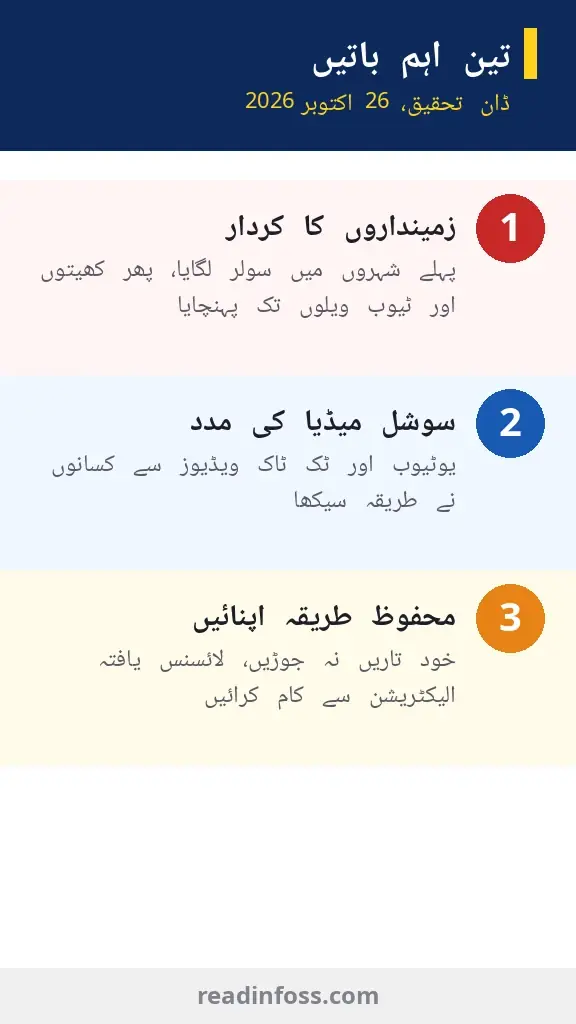
The feature’s first finding is the role of landlords as brokers of the technology. Solar’s first wave in Pakistan was among well-off urban households, including landowning families who move regularly between city houses and rural farms. Having found solar cost-effective at home, many brought panels and know-how to farms served by diesel tubewells. One Multan landlord quoted in the feature first installed a 22-kW system in 2010, when solar was at its costliest, and has kept expanding since.
The second finding is the demonstration effect. Once a landlord’s farm was solarised, neighbours could see the technology working and ask someone they trusted about it. A Lahore distributor quoted in the feature put it bluntly: farmers will not be impressed by an unknown city salesman, but they will trust people in their own locality. Every small-scale and tenant farmer interviewed had travelled to see panels before buying their own. In a few cases landlords gifted panels: one Muzaffargarh tenant renting five and a half acres said his landowners brought him eight panels six months ago and taught him to connect them to his tubewell, with no change to his rent.
The third finding is social media as the instruction manual. YouTube and TikTok, the feature reports, carry thousands of videos in Urdu and Punjabi covering brands, system sizing, wiring, elevated structures and maintenance. It names examples: Multan distributor Kamal Solar House, with 122,000 TikTok followers, and electrician Usman Jutt Technical, with 201,800 followers whose last three videos had a combined 10.5 million views. One farmer in Qila Mian Singh said he installed tubewell panels a year ago from a YouTube tutorial, calling it “just two wires: one is hot, and one is cold”. A shopkeeper, the feature says, needed only TikTok to set up a single stick-propped panel powering a cooler.
Read that paragraph carefully, because it is where the danger lies. A quote about how simple something felt to one person is not a safety assessment, and a panel propped on a stick is not an installation standard. Tubewell and household solar wiring carries mains-level voltages, and a wrong connection can injure, kill, start a fire or destroy an inverter. The safe steps below deliberately contain no wiring instructions.
What the Numbers Say — The Wider Solar Picture
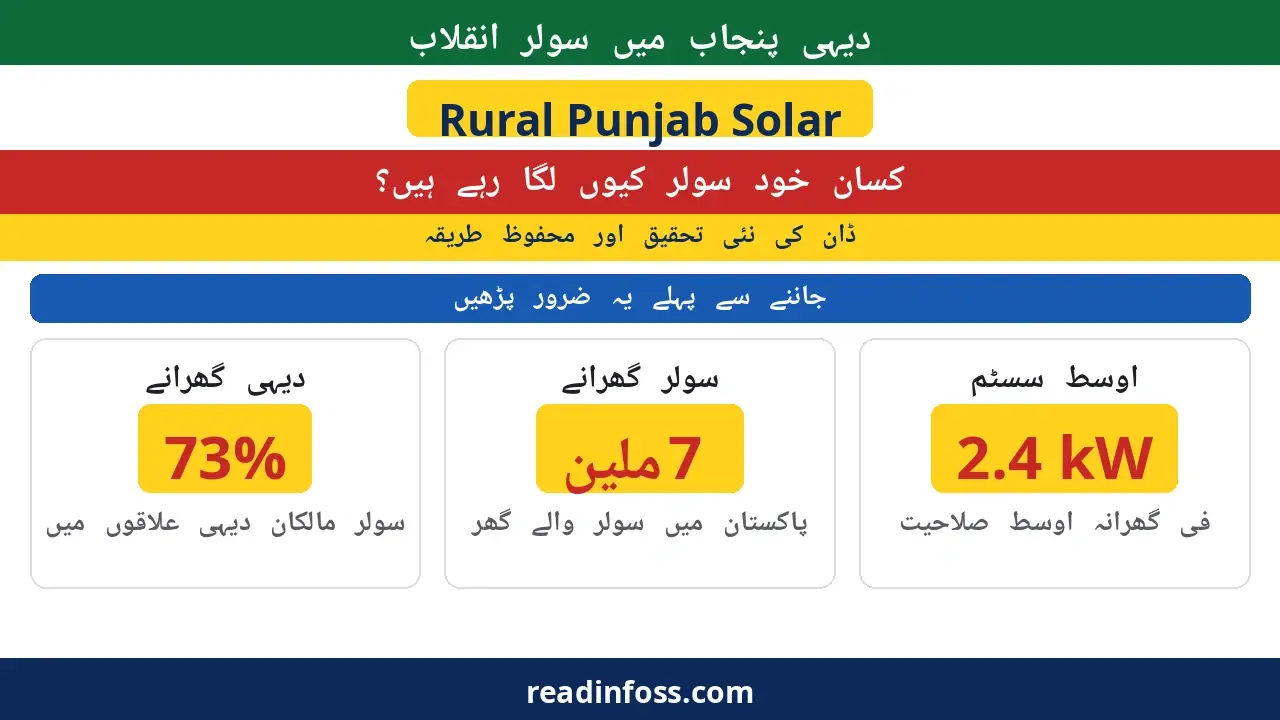
Dawn’s feature cites think tank Ember for the claim that 73 per cent of panel owners are now rural. Ember’s own analysis, which this guide checked, states it more precisely: while 60 per cent of Pakistan’s population is rural, 73 per cent of solar-owning households are rural. The figure is about households that own solar, not panels or villages, and this guide uses Ember’s wording.
| Detail | Current research finding |
|---|---|
| Solar-owning households in rural areas | 73% (Ember; population is 60% rural) |
| Households with solar in Pakistan | About 7 million of 40 million households — almost a fifth (18%) |
| Total household solar capacity | 16.9 GW, averaging 2.4 kW per household — roughly five panels |
| Why rural adoption is high | Least reliable electricity supply, long outages, and in some cases no grid connection at all (Ember) |
| Who adopted first | Concentrated among higher-income households able to fund upfront costs or access financing (Ember) |
| Underlying source | Renewables First’s “Customer Owned Renewable Electrification” report, via Ember’s solarisation analysis |
Two cautions belong with these numbers. First, they describe the national picture, not Punjab alone: Dawn’s fieldwork was in Punjab, while Ember’s 73 per cent figure is for Pakistan as a whole — do not quote it as a Punjab-only statistic. Second, household counts differ by definition: Pakistan’s household survey found about 7 per cent of households using solar for lighting alone and another 11 per cent using grid plus solar together, totalling the same 18 per cent. Treat any single figure as an estimate, not a census.
What the numbers do explain is the motive Dawn’s interviewees describe: unreliable and unaffordable grid electricity, plus diesel costs, made solar an economic decision first and an environmental one second. Several interviewees said they had gone hungry to save money for electricity bills before switching. That desperation is also why the scam risk is high: a forwarded message promising free panels gets shared before it gets checked.
Is This the Punjab Free Solar Panel Scheme? No — Do Not Confuse the Two
This is the most important section of this guide: the Dawn feature and the government scheme share the same words — Punjab, solar, farmers — but are different things. The Dawn feature describes private, citizen-led adoption: people buying panels themselves. The CM Punjab Free Solar Panel Scheme is a government programme with fixed eligibility, a fixed original round, and balloting. Reading one as the other leads to the mistakes warned about below.
| Detail | Dawn feature (private adoption) | CM Punjab Free Solar Panel Scheme (government programme) |
|---|---|---|
| What it is | Field research on how rural households adopted solar themselves | Government scheme offering small solar systems to qualifying domestic consumers |
| Who pays | Households, landlords, or informal help — no government payment described | Government-funded systems for selected applicants (original round) |
| How you get it | Buy from a shop or distributor; no application | Application, verification and computerised balloting (original round only) |
| Registration today | Not applicable | Not confirmed open — see status table below |
| Scheme detail | Status as reviewed in October 2026 |
|---|---|
| Original-round target | Up to 100,000 solar systems for qualifying households |
| System sizes in the original round | 550W for consumers using up to 100 units; 1,100W for 101–200 units |
| Eligibility snapshot (original round) | Domestic consumers in Punjab using up to 200 units, June 2024 bill as reference, sanctioned load up to 2 kW |
| Original registration deadline | 5 January 2025 — closed |
| New registration window in 2026 | Not confirmed. Guides reviewing official pages in October 2026 report no verified new window |
| Implementation extension reported | Associated Press of Pakistan reported in April 2026 that the programme period was extended until December 2026 — an extension of implementation, not a reopening of registration |
| Published official portal | cmsolarscheme.punjab.gov.pk — check the portal itself for any current notice before acting |
| Original-round SMS route | 8800 was the published route for the original round — historical information only; do not treat an old code as proof a new round is open |
The practical rule follows from that table: a scheme being “extended until December 2026” does not mean “apply now”. Extension of distribution to people already selected is not a new application window. Any website or WhatsApp message telling you to submit a fresh application today — especially one naming a new deadline such as 30 November 2026 — must be able to show a current, dated government notice. A forwarded message, a Facebook ad and an agent’s word are not notices. If you already applied in the original round, check your existing application through the official portal; do not re-apply through an unofficial site. Full detail is in readinfoss’s Punjab Free Solar Panel Scheme 2026 guide.
One more confusion to avoid: the Dawn feature’s title uses “hotwiring” as a headline metaphor for informal, self-taught installation. It is not a scheme name or a technique to search for and copy.
How to Go Solar Safely — Without Copying DIY Wiring
If the Dawn story has made you consider solar, the safe route is slower than a TikTok video and cheaper than a mistake. These steps contain no wiring instructions by design: connections, earthing and inverter setup belong to a licensed electrician, not to a video.
- Check the scheme question first. Before spending anything, check the official scheme portal for any current notice. If there is no current notice, assume no new round is open, and do not pay anyone who claims otherwise.
- Do not share CNIC or bill details on unofficial sites. Your CNIC number and electricity bill reference number are enough for misuse. Enter them only on the official portal, never on a blog, ad landing page or agent’s form.
- Get written quotes from two or three licensed installers. Panel brand and wattage, inverter brand and capacity, mounting, earthing, warranty terms and total price should all be in writing — a verbal warranty promise is worth very little when an inverter fails.
- Size the system from your actual bill and load, not from a video. A system that runs a shop fan and cooler is not the same as one that runs a tubewell. Show the installer your bills and appliances, and ask what the system will and will not run during an outage.
- Insist on proper mounting and a licensed connection. Panels need a fixed, wind-safe structure, not a bamboo stick or a table, and all connections must be made by a qualified electrician. Ask who is responsible if something fails, and get it in writing.
- Sort net metering only through your distribution company. If you plan to export extra electricity to the grid, follow your DISCO’s net-metering process and get written approval. A seller’s promise that net metering is “included” is not an approval.
- Plan for security and maintenance. Dawn’s feature itself reports a farmer sleeping beside his panels to guard them from thieves. Budget for secure mounting and, where needed, a locked or supervised location, and ask the installer about cleaning and basic checks you can safely do yourself — with the system isolated, as instructed.
For current market prices, see readinfoss’s Solar Panel 550 Watt Price in Pakistan Today guide. This article deliberately quotes no panel price: prices move by brand, wattage and city, and a single unverified figure would mislead more than it helps.
Common Mistakes to Avoid
- Copying DIY wiring from a video. A tutorial cannot see your wiring, your load or your earthing. Mains and tubewell voltages can injure or kill, and faulty work can void warranties.
- Assuming the Dawn feature means free panels are available. It does not. Private adoption and the government scheme are different things, and no new scheme round is confirmed open.
- Paying an agent for “guaranteed” selection or registration. The original scheme used balloting, not payment. Anyone selling a guaranteed result is running a scam.
- Entering your CNIC or bill reference on an unofficial website. Blogs that copy the scheme’s name are not the scheme. Check the portal itself.
- Buying a single panel on a stick and calling it a system. Unsecured panels are a theft risk, a wind risk and a damage risk, and a single panel will not run a tubewell.
- Trusting a forwarded deadline. A date in a WhatsApp message is not a government notice. Check for a dated notice on an official channel before acting.
- Skipping the written warranty. Panel and inverter warranties, and who honours them, matter more than a small difference in quoted price.
- Assuming net metering is automatic. Exporting to the grid needs DISCO approval. Do not buy on the assumption that it will be granted.
FAQs
Is Dawn’s “Hotwiring rural Punjab” story about a new solar scheme? No. It is a reported feature, published 26 October 2026, about how rural households in Punjab adopted solar privately — through landlord examples and social-media tutorials. It announces no scheme, no subsidy and no deadline.
Can I apply for the Punjab Free Solar Panel Scheme now? Not on any evidence reviewed for this guide. The original round’s deadline was 5 January 2025, and guides reviewing official pages in October 2026 report no verified new window. An implementation extension until December 2026, reported in April 2026, is not a reopening of registration. Check the official portal for any current notice.
What does the 73 per cent figure actually mean? Ember’s analysis states that 73 per cent of Pakistan’s solar-owning households are in rural areas, while 60 per cent of the population is rural. It is a national household figure, not a Punjab-only figure and not a count of panels.
Is it safe to install solar panels myself after watching a video? No. The videos Dawn describes show people doing it, but household and tubewell solar work involves voltages that can cause serious injury, fire and equipment damage. Use a licensed installer and a qualified electrician for all connections.
Why did rural Punjab adopt solar so fast? Dawn’s research points to two reinforcing causes: landlords who demonstrated working solar on their farms to people who trusted them, and Urdu and Punjabi tutorials that made the technology feel familiar. Behind both sits unreliable grid supply and diesel costs, which Ember also identifies as drivers.
What should I do if someone asks me to pay for free-solar registration? Do not pay, and do not share your CNIC or bill details. Report the approach through the official channel where possible, and check the official scheme portal yourself before believing any claim.
Final Thoughts
Dawn’s feature is worth reading for what it actually shows: in rural Punjab, solar spread not through a single programme but through trusted neighbours and phones — landlords who proved it worked, and videos that made it feel learnable. The national numbers back up the scale: nearly a fifth of Pakistani households now use solar, and almost three quarters of solar-owning households are rural.
But a story about how people taught themselves is not an instruction to teach yourself, and it is not a government offer. Keep three things apart: the Dawn feature, the wider Ember numbers, and the Punjab free solar scheme, whose original round is closed and whose new round is unconfirmed. Use only official channels for any scheme claim, use a licensed installer for any real installation, and never pay an agent for a result no one can guarantee.